
Google review analysis for hotel check in: audit arrival friction before peak season
A guest writes that check-in took too long. Another says the room was not ready. A third complains that the front desk gave different information from the booking confirmation. These comments may describe one arrival problem, or three separate problems that need different owners. Reading them as a single complaint can send a hotel toward the wrong fix.
Google review analysis for hotel check in is useful when the hotel starts with a precise operational question. It can help a manager organize what guests publicly say about queues, room readiness, directions, deposits, or arrival expectations. It cannot show occupancy, staff schedules, reservation notes, or the actual reason a room was released late. Those answers remain inside the hotel.
Customer Feeling review analysis works with public Google Maps reviews and sends a report by email. The published service description says the report organizes recurring praise and complaints and suggests areas to review. It does not say that the service connects to a property management system, reads private profile metrics, or includes reviews from every booking platform. That boundary should shape the question you ask before buying.
Define the arrival decision before commissioning a report
“Improve check-in” is too broad to guide a useful investigation. Decide what the hotel may change if the evidence supports it. You might review the wording of the pre-arrival message, the handoff between housekeeping and reception, the way the desk explains a deposit, or the process for informing guests when a room is not ready. Each choice needs different internal evidence.
Write the decision in one sentence before ordering a report. For example: “We need to know whether public reviews repeatedly describe unclear arrival instructions, and whether those comments justify revising our pre-arrival message.” This wording keeps the investigation close to what review text can support. It does not ask the report to prove why guests arrived without the right information.
Before paying, view a sample report. Look at how the findings are presented and decide whether your front-office manager can turn that format into a short internal investigation. A sample can help you judge fit, but it does not predict what themes will appear for your property.
Separate queues, room readiness and expectation gaps
Guests often use “check-in” to describe the entire period between arrival and entering the room. A long check-in comment might refer to a physical queue, an identification or payment step, a room that was still being prepared, difficulty finding the desk, or a disagreement about what the reservation included. Grouping all of those comments under “slow service” hides the point at which the experience broke down.
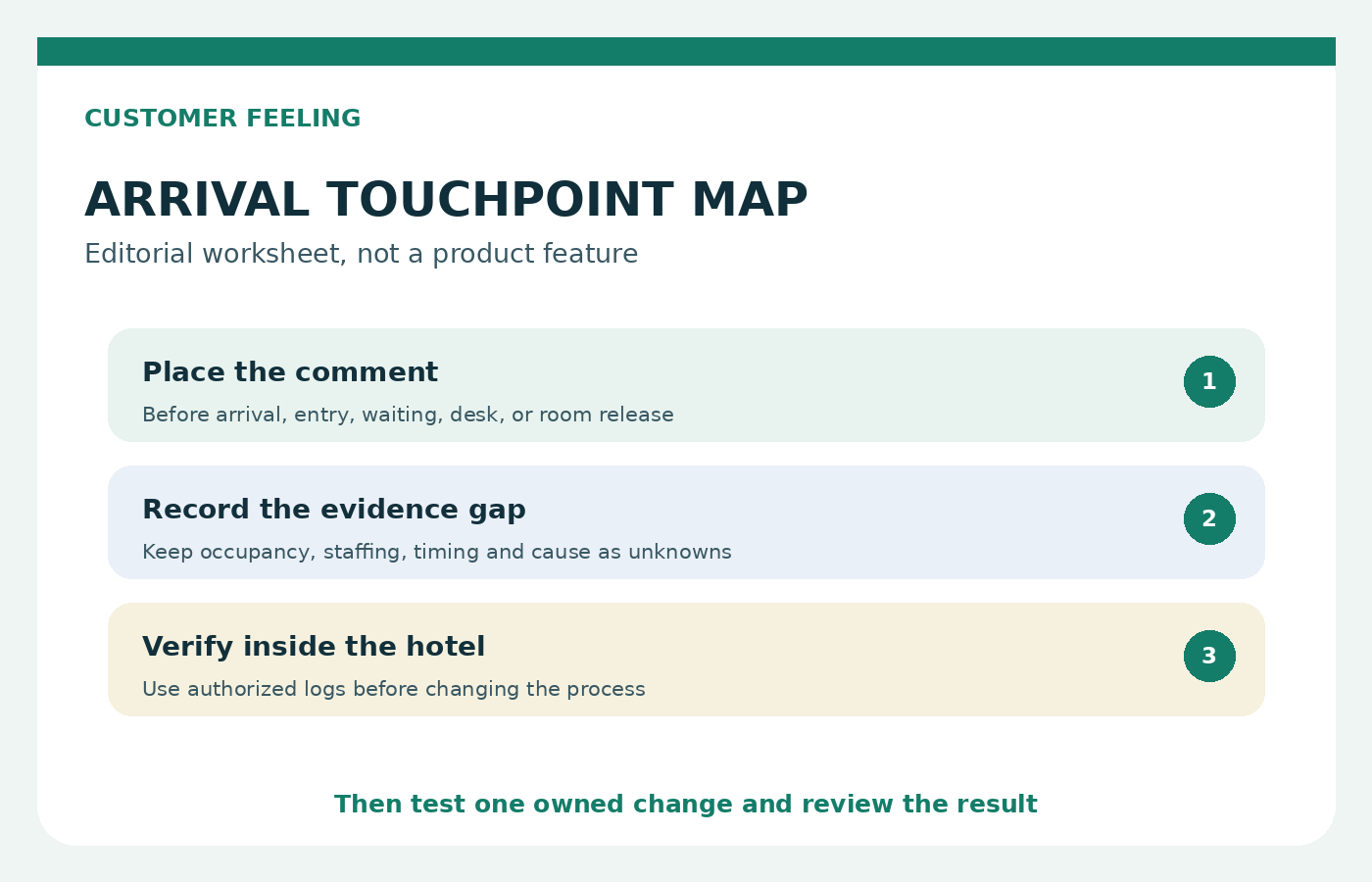
Use an arrival touchpoint map. Start with five neutral stages: before arrival, entry and directions, waiting, desk transaction, and room release. Place each review statement only where its words support placement. If a guest says the room was not ready, record a room-release concern. Do not automatically label it a housekeeping failure. If the review says the process was confusing but gives no detail, keep it in an unresolved column rather than guessing the stage.
Expectation gaps deserve their own line. A guest may expect early access, a particular payment method, or an included service because of information seen elsewhere. The review can show that the expectation existed and that the guest was disappointed. It does not establish which page, message, employee, or third party created the expectation. Compare that theme with the hotel’s current booking and pre-arrival information before changing front-desk instructions.
Do not infer occupancy or staffing levels from reviews
A cluster of delay complaints can justify a closer look, but it does not calculate the number of employees the hotel needs. Public reviews rarely contain a complete arrival count, desk roster, room status, time stamp, or service duration. Even a specific comment such as “only one person was at the desk” describes what one guest noticed at one moment. It does not show the full staffing plan or the work happening out of view.
Avoid turning frequency into certainty. If several reviews mention waiting, record that waiting is a recurring public concern in the reviewed material. Then ask an internal question: during the relevant periods, did arrival volume, transaction time, system availability, or room-release timing differ from the plan? The hotel may find a staffing issue, a process issue, an information issue, or no reliable match at all.
Google Business Profile performance does not close this gap. Google says verified profile owners and managers can view applicable metrics such as views, directions, calls, website clicks, and interactions. Hotels may also see booking-link clicks when that metric applies. These numbers describe how people find and interact with the profile. They do not identify the cause of a check-in complaint, and Customer Feeling does not claim access to the hotel’s private performance data.
Cross-check themes with internal arrival logs
Use a simple evidence table with four columns: public statement, what it supports, what remains unknown, and internal source to check. A comment saying “we waited in the lobby because the room was not ready” supports the existence of a reported wait and a reported readiness issue. It does not show the booked arrival terms, the room status history, or the cause. Those unknowns belong in the table instead of disappearing from the decision.
- Public statement: the guest reports a long wait after arrival.
- Supported observation: waiting is part of that guest’s described experience.
- Unknown: arrival time, queue length, room status, cause, and whether the case was typical.
- Internal check: review the appropriate arrival and room-release records under hotel policy.
- Possible next step: test a narrowly defined communication or process change only if the internal evidence supports it.
This example is an editorial method, not a Customer Feeling product feature or a result from a real hotel. Its purpose is to stop a public comment from becoming an unsupported diagnosis. If the internal record conflicts with the review, preserve both facts. The guest’s impression still matters, but the hotel should not rewrite its records to make the story tidy.
Write a front-desk change brief that can be checked
A useful change brief is small enough to own. Give it a problem statement, evidence, unknowns, an owner, an action, and a review point. Suppose reviews repeatedly describe uncertainty when rooms are not ready. After checking the hotel’s records and policy, the brief might ask the front-office lead to test a clearer explanation of available options. It should not promise immediate room access or claim the wording will improve ratings.
Assign one owner. A change shared vaguely by reception, reservations, housekeeping, and marketing often belongs to nobody. The owner can collect feedback from other teams, but one person should know which version of the message or procedure is being tested and when it will be reviewed. Use the hotel’s own operating measures to judge the test. A later review may add context, but one new comment cannot prove success or failure.
Analysis and response are separate jobs. Google says a verified business can reply to reviews and that an approved reply is posted publicly beneath the customer’s review. Do not place reservation details, room numbers, payment information, or personal explanations in a public reply. A report can inform how the hotel thinks about a theme, but it does not replace the hotel’s response policy or private service-recovery process.
Decide whether one location report answers the question
A single report may be a sensible first purchase when you have one location, a clear arrival question, enough substantive public comments to examine, and a manager ready to verify the findings. Customer Feeling publishes a single-report option for testing the service or reviewing one location. The site also offers a report pack and a monthly option, but a larger plan does not make weak or irrelevant review text more informative.
Check the source boundary. The published service scope refers to public Google Maps reviews for the location you provide. If your operational question depends on comments held only by a booking platform, private survey, call center, or property management system, do not assume those sources are included. Ask about scope before purchase, or analyze those authorized sources separately inside the hotel.
Use this pre-purchase check:
- The location and arrival decision are named.
- The question can be investigated from public Google review text.
- The hotel has an internal owner and authorized records for verification.
- No one expects the report to calculate staffing, prove causes, or access private systems.
- The sample report format suits the intended internal discussion.
- Unanswered scope questions will be raised before payment.
If the source coverage or report format is unclear, contact us before choosing a plan. When the fit is clear, review the plans against your question and location needs. Buy the smallest scope that your team can verify and use responsibly.
Frequently asked questions about hotel review analysis
Does the report include booking platform reviews?
The public Customer Feeling scope describes analysis of public Google Maps reviews for the location link you provide. It does not state that booking-platform reviews are included. If those reviews are central to your question, confirm the scope before purchase rather than assuming broader coverage.
Can reviews prove the hotel needs more staff?
No. Reviews can show that guests reported waiting or difficulty getting help. They do not provide a complete arrival count, roster, workload, transaction time, or cause. Use the theme to start an internal staffing and process review, then rely on the hotel’s authorized operational records for the decision.
What if most reviews discuss rooms rather than check-in?
Do not force them into an arrival analysis. If the text says little about arrival, the report may not answer your check-in question. You can narrow the decision, wait for more relevant evidence, or ask whether a different report question fits the available comments.
Does Customer Feeling need access to the hotel’s Google account?
The service page says the analysis uses public reviews and does not require your Google account password. The request uses the Google Maps location link and purchase email. Private Business Profile performance data and hotel operational systems are outside the published scope.
Sources and scope
The product boundary and plan descriptions in this article come from the Customer Feeling English service page. Google’s official pages on Business Profile performance and insights and managing customer reviews support the distinctions between private profile metrics, public review text, and public replies. The arrival map and change brief are editorial tools for this guide, not advertised product features or hotel performance claims.