
Google review analysis for auto repair shops: investigate estimate and invoice complaints
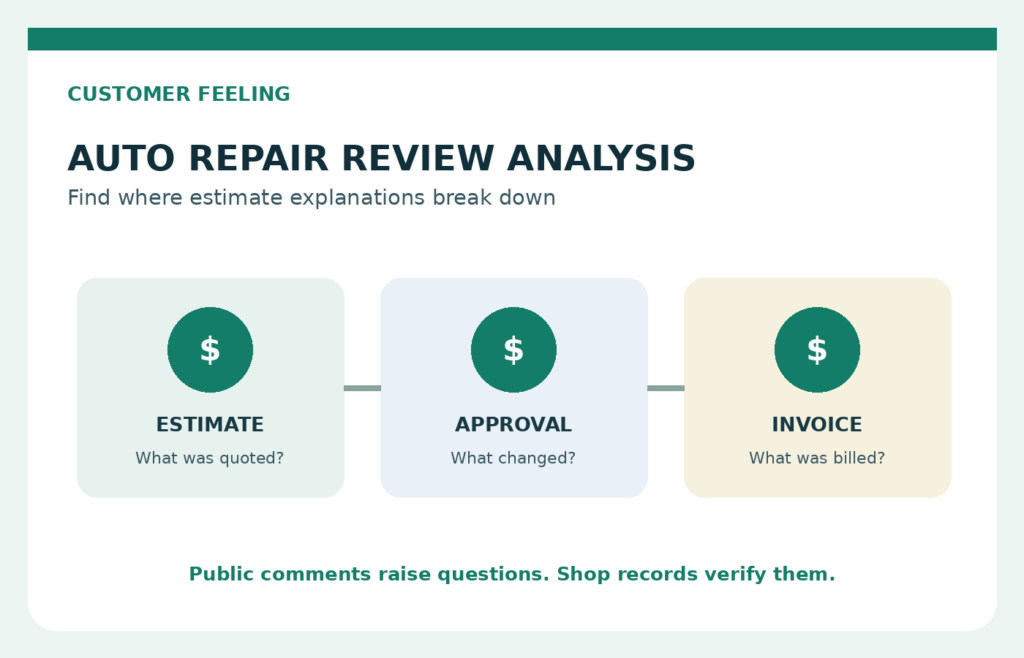
An auto repair customer can describe a bill as “too high” when the real complaint is about something else. The first quote may have changed without a clear explanation. A diagnostic charge may have been understood as part of the repair. Extra work may have appeared on the final invoice even though the customer does not remember approving it. Those are different problems, and each points to a different part of the shop’s process.
Google review analysis for auto repair shops can help an owner find repeated comments about estimates, approvals, price changes and final invoices. It cannot decide whether a particular charge was correct. Public reviews show what customers remember and choose to describe. The repair order, estimate, authorization record and invoice remain with the shop.
Customer Feeling review analysis works with the available public reviews connected to the Google Maps location supplied by the buyer. Its public page says recurring praise and complaints are organized into a practical report delivered by email. That makes the service a possible starting point for a focused investigation, not an audit of repair files or a ruling on a dispute.
Frame the decision around estimate approval
Begin with the decision you may make after reading the report. “Fix pricing” is too broad. A useful question is narrower: should service advisers change how they explain diagnostic charges, record approval for added work, or walk customers through the difference between an estimate and the final invoice?
This matters because a review often compresses several conversations into one sentence. “They quoted one price and charged another” could refer to added parts found after diagnosis, a tax or fee that was not discussed, a misunderstanding about the original scope, or a genuine documentation failure. The review supports a question. It does not settle which explanation is true.
Write one investigation statement before ordering a report: “We want to know whether public comments repeatedly describe unexpected changes between the initial estimate and final invoice.” Add a boundary beneath it: “We will verify any pattern against authorized shop records before changing policy or judging an employee.” This keeps the report tied to a decision the business can actually examine.
Distinguish perceived price from unexplained changes
Code comments by the experience described, not by whether the reviewer sounds angry. A complaint that a repair was expensive is about perceived price or value. A complaint that the bill changed after approval concerns scope control. A complaint that nobody explained the diagnostic fee concerns communication. A complaint about a line item the customer does not recognize concerns invoice clarity.
Those categories can overlap. A customer may accept a high price when the adviser explains the work, options and authorization step clearly. Another customer may object to a smaller amount because it arrived as a surprise. Combining both under “price complaints” hides the process you need to inspect.
Use cautious labels such as “price felt high,” “change not understood,” “approval disputed,” “fee not explained,” and “invoice hard to read.” Avoid labels like “overcharged” or “unauthorized repair” unless an authorized investigation has established that fact. The distinction protects the customer from being dismissed and protects staff from a conclusion that public text cannot support.
Build a quote-to-invoice evidence map
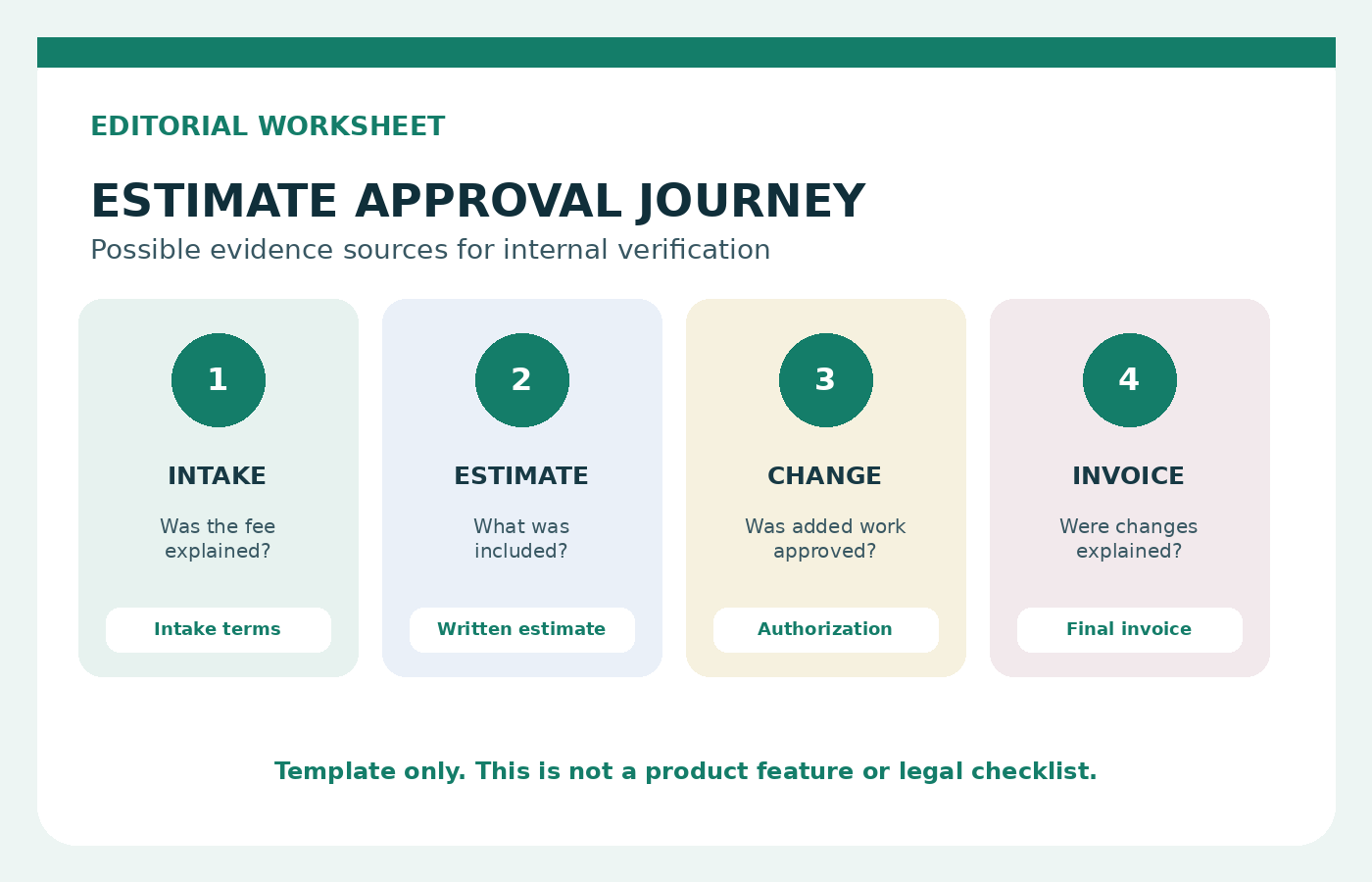
The following map is an editorial worksheet, not a Customer Feeling product feature. It turns a review theme into questions for the shop’s own records. Keep it blank until you have evidence.
| Customer touchpoint | Review language to notice | Internal evidence to check | Question for the owner |
|---|---|---|---|
| Vehicle intake | “I was not told about a fee” | Intake form and diagnostic terms | Was the charge explained before diagnosis? |
| Initial estimate | “The quote was vague” | Estimate, parts and labor detail | Could a customer tell what was included? |
| Added work | “The price changed later” | Call, text or electronic authorization record | Was the new scope explained and approved? |
| Vehicle collection | “The bill made no sense” | Final invoice and adviser notes | Did someone explain the changes and line items? |
The U.S. Federal Trade Commission advises consumers who proceed with work to ask for a written estimate. It also recommends obtaining a completed repair order that describes the work and lists supplied parts, their costs and labor charges. California’s Bureau of Automotive Repair gives more specific state guidance about estimates, authorization for repairs and added work, and final invoices. Requirements vary, so use the rules that apply where your shop operates rather than treating one jurisdiction’s checklist as universal law.
Check complaints against authorized job records internally
Once the report identifies a repeated theme, sample the relevant jobs from your own records. Customer Feeling’s public service description does not say it accesses repair orders, invoices, shop management software, payment details or private messages. Do not upload those records simply because the report raises a question. Keep the verification inside the business and limit access to staff who are authorized to review the files.
For each sampled job, compare the original estimate with later authorizations and the final invoice. Record whether the amount changed, why it changed, how the customer was contacted, what they approved, and whether the invoice reflects the authorized work. If the review cannot be matched safely and confidently to a job, leave it unmatched. Guessing from a name, vehicle description or date creates privacy and accuracy risks.
Look for process gaps across the sample rather than trying to defeat each reviewer. Perhaps approvals are documented but advisers rarely explain diagnostic fees at intake. Perhaps final invoices are accurate but use descriptions customers cannot connect to the earlier estimate. Perhaps records are inconsistent between advisers. Each finding needs a different response.
Protect names, vehicle and payment details
A public reply is the wrong place to prove your side with invoice details. Google says approved business replies appear publicly below reviews. Its Maps policy also restricts personal information, including financial and identification information. Do not publish a customer’s full name, phone number, vehicle identification number, license plate, payment method, invoice number or repair history in a reply.
A short response can acknowledge the concern and invite the reviewer to continue through a private channel. Avoid confirming that the person was a customer if doing so would reveal information. Never paste the internal authorization trail into the response, even when it appears to support the shop.
Use the same restraint in the investigation worksheet. A manager usually needs a record reference, issue category, verification status and process owner, not copied payment data or a full vehicle profile. If a review itself exposes sensitive details, handle that content under your privacy and platform procedures rather than reproducing it in presentations.
Turn a review theme into a process test
A recurring complaint can support a small process test after internal verification. Suppose several reviews say the final amount was a surprise, while the sampled files show that added work was approved. The first test may be communication rather than a pricing change: ask advisers to restate the revised total, explain what changed, and provide the updated authorization in the channel the shop normally uses.
Define what staff should do and what evidence will show that they did it. Review a modest set of later jobs for complete authorization records and clear invoice explanations. Then read newer feedback for the same theme. A change in public comments may be useful context, but it does not prove that the process caused the change. Job records and direct customer conversations still matter.
If the internal sample reveals genuinely missing approvals, unexplained charges or inconsistent invoice practices, involve the appropriate owner, compliance adviser or legal counsel for your jurisdiction. A review report can point to the area. It cannot determine legal liability or replace a formal complaint investigation.
Decide whether one location report fits the question
A report is a reasonable first purchase when one shop has enough substantive public comments to examine and the owner has a specific estimate or invoice question. The available review text matters more than the star count alone. A page full of ratings without written detail may offer little evidence about authorization or price explanations.
Before buying, view a sample report to understand the published format. The sample shows a general customer sentiment report, not an auto repair case study and not a promise that your report will contain the same sections, quantities or findings. The service page also says the quality and detail of findings depend on the available reviews.
If you are unsure whether your reviews discuss estimates or invoices with enough detail, contact us before choosing a package. Ask about fit without sending invoices, card information, Google credentials or sensitive vehicle records. If the scope matches your question, Review the plans against your question and location needs.
Frequently asked questions
Can the report establish whether an invoice was wrong?
No. A report based on public reviews can organize what customers alleged or found confusing. Establishing whether an invoice was wrong requires the estimate, repair order, authorization trail, invoice and the rules that apply to the transaction. Those checks belong inside the business or with the appropriate adviser or authority.
Does Customer Feeling access repair invoices?
The public service page says the analysis uses available public reviews from the Google Maps location supplied by the customer. It does not advertise access to repair invoices, shop management systems, payment records or private Google Business Profile data. This article’s internal evidence map is an editorial tool for the shop, not a service integration.
What if customers do not explain the price complaint?
Classify the comment as vague rather than assigning a cause. You can count it as a general price concern, but it cannot tell you whether the issue was labor cost, parts cost, a diagnostic fee, added work or invoice presentation. More detailed reviews and internal records are needed.
Should the shop reply to every estimate complaint with its records?
No. Replies are public, so avoid customer, vehicle, repair and payment details. A brief acknowledgment and a private contact path are safer than debating the transaction in public. Review the relevant records internally before making any factual statement about the job.