
Your pre-sale customer experience review: prepare your own business for sale
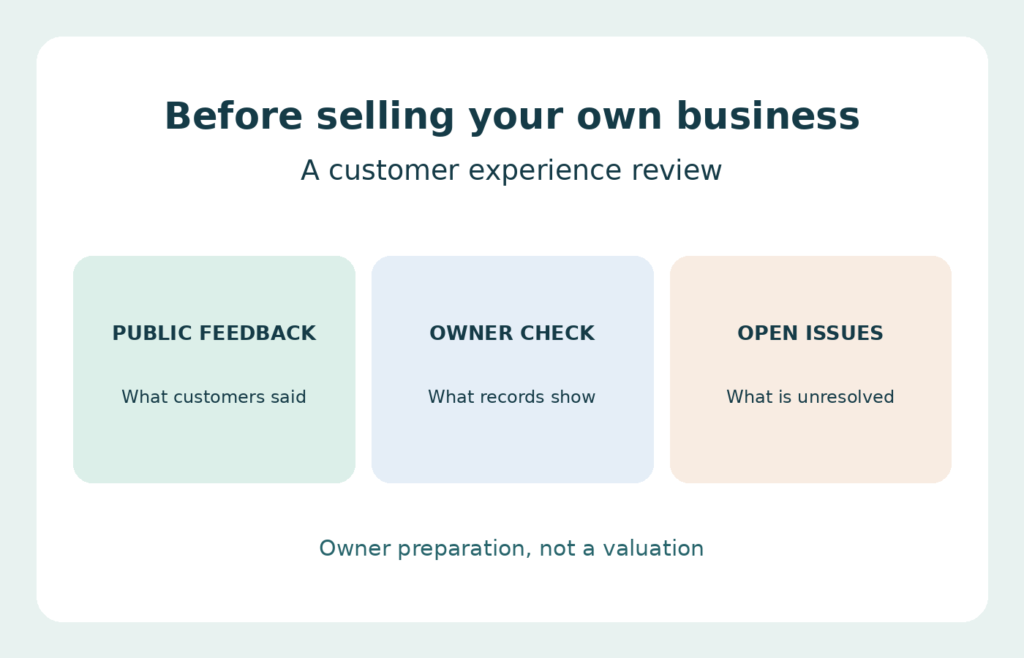
If you are preparing to sell your own business, customer feedback belongs on your preparation list, but it should not be mistaken for a valuation. A pre-sale customer experience review helps you identify what customers have said publicly, what your team has checked internally, and what remains unresolved. It gives you a more honest account of the operation you run today. It cannot tell you what a buyer will pay.
The point is not to polish a rating before a listing goes live. It is to catch recurring service questions early enough to investigate them, preserve a record of what you did, and discuss open issues with your advisers. Customer Feeling review analysis concerns available public Google Maps reviews for a location you provide. Your own operational records and conversations with customers are separate sources; neither replaces the other.
Define the review around the business you own
Begin with the actual locations and customer journeys included in the proposed sale. A restaurant owner might examine ordering and collection; a repair shop owner might examine estimates and handover. These are prompts for your internal review, not claims that a particular problem exists. If several branches are involved, keep each location’s Google Maps link and operating context distinct. A complaint about one address should not silently become a claim about the entire company.
Write down a review period for your own notes, the date you gathered each source, and who can check the underlying records. Do not assume that an external report can retrieve every historical review or apply the same date range you use internally. Ask what coverage is available for the exact location before treating a summary as comprehensive. Where there are few substantive reviews, say so; a thin public record is an evidence limit, not proof that customers have no concerns.
This guide is for an owner examining their own business, not a competitor or an unowned location. If a listing moved or changed names, confirm its location and dates before interpreting feedback.
Keep public feedback apart from transaction diligence
Public review text can suggest questions about service consistency or expectations. It does not establish revenue, customer concentration, contract quality, liabilities, asset condition, or the value of the business. The Business Development Bank of Canada’s explanation of transaction diligence separates commercial, financial, and legal work and advises sellers to prepare records with accountants and lawyers. Use qualified advisers for those parts. An attractive review chart cannot substitute for signed contracts or reconciled accounts.
Keep a separate folder for internal evidence rather than feeding sensitive transaction material into a public-review exercise. Customer complaints may touch delivery, staffing, or availability; confirm those issues with service logs, refund records, staffing schedules, or inventory information held by your business, as appropriate. Handle personal details carefully and share only what your advisers need through suitable channels. A reviewer’s public comment is not permission to republish private customer or employee details in a sale document.
Tell your adviser what this covers: dated public feedback for named owned locations, followed by your team’s investigation. It certifies neither transaction readiness nor complete representation of customers.
Read patterns as leads, not verdicts
Suppose several comments mention delayed collection, while another praises fast service. Neither group alone settles whether the current handover process works. Note the dates, location, specificity, and possible differences in channel or shift. Then ask the manager to trace the handover process using internal evidence. You may find a fixable bottleneck, a change that has already been made, or too little information to explain the comments. Record the answer you can support, not the answer that looks best in a sale pack.
A rating is especially easy to overread. It compresses different experiences into one number and says little about the cause of a complaint. Do not turn a rise or fall into a claim about revenue, future retention, or sale price. A single serious report can deserve investigation even when it is uncommon; a frequent minor irritation may still matter operationally. Prioritize your investigation by severity, recency, and whether the underlying process is within your control, rather than treating comment frequency as a scientific ranking.
Old comments require context. If hours, management, location, or service design changed, note the change and its effective date. Do not delete the old evidence from your worksheet merely because it no longer describes the current process. Conversely, don’t claim the problem was solved solely because later reviews are quiet. Check an operational record and keep the result, including cases where the outcome remains inconclusive.
Resist reputation shortcuts. Google’s Maps contribution policy prohibits paid or incentivized reviews and discouraging negative reviews or selectively asking only happy customers. Ask for genuine feedback without steering its rating or content. Your pre-sale preparation should be about understanding and correcting the operation, not manufacturing a cleaner-looking review profile.
Make an owner action worksheet
A useful worksheet is deliberately small. Give each issue one row with a feedback source and date, the location, the exact question raised, an internal record to check, the person responsible, the action considered, a verification method, and its current status. Add a separate column for evidence gaps. You can create this in a document or spreadsheet you control; it is an editorial template, not a promised feature of any report provider.
For example, write “collection wait mentioned in public feedback” as an observation, not “collection system is broken.” The manager can compare that observation with dated order and handover records, then document any change to staffing or instructions. Verification might involve checking those same records after the change and reading later relevant feedback. If records are missing, mark the gap rather than inventing a before-and-after result.
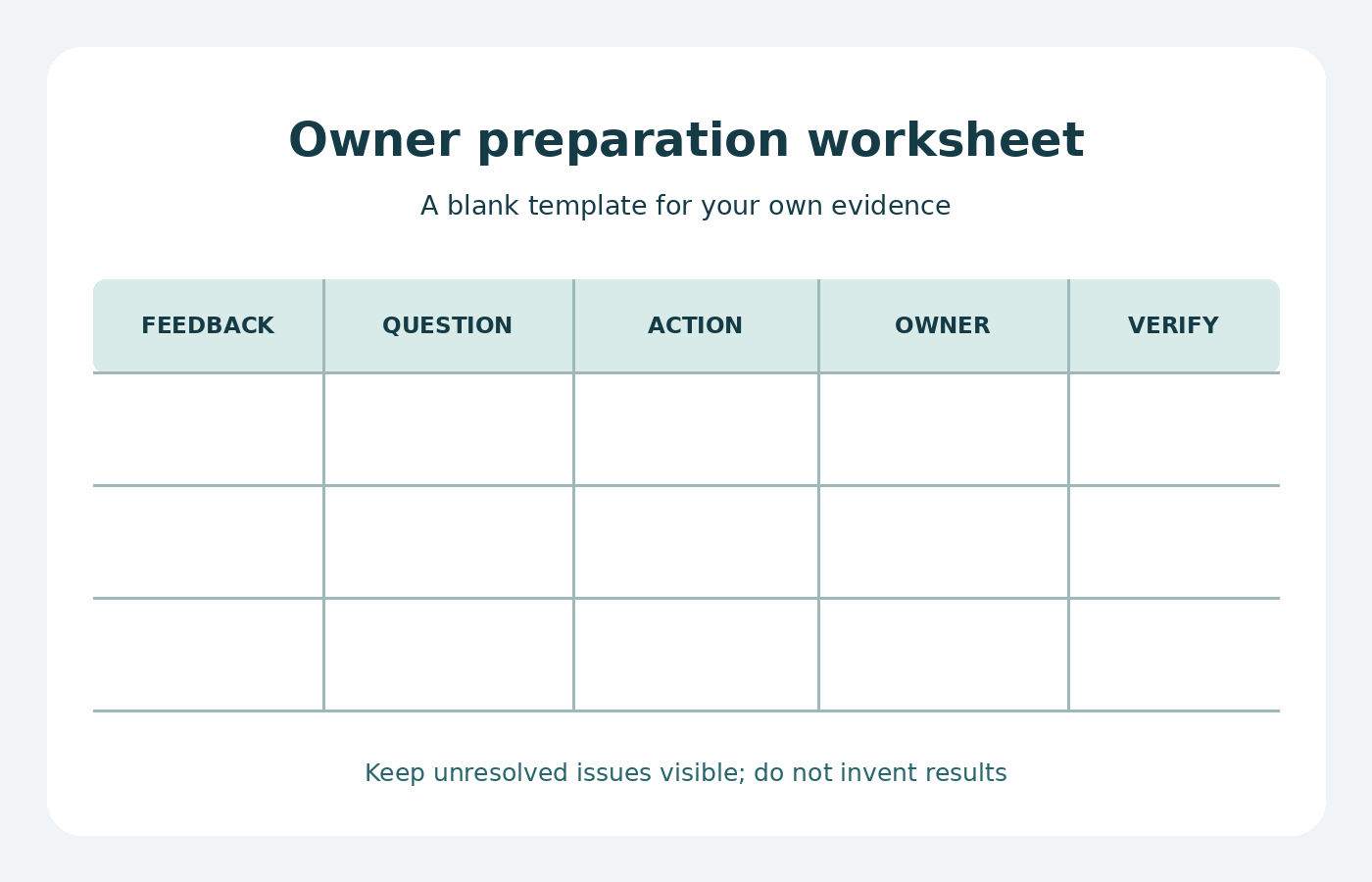
Put the worksheet owner and review date at the top. Label each row “investigating,” “action implemented, not yet verified,” “verified against internal records,” or “unresolved.” Store supporting records securely without copying unnecessary personal data into the sheet.
The worksheet is also a way to decide where you should spend your own time. If a subject has credible feedback but no internal record, improving recordkeeping may be the first action. If the issue is outside the business you are selling, correct the scope. If a customer describes a safety concern, use the appropriate internal escalation rather than waiting for another report. An owner can document the decision without pretending the evidence answers every question.
Document changes without hiding what remains open
Before a sale discussion, preserve versions of your worksheet and supporting notes. Record when a policy changed, who approved it, and what you checked afterward. A change made last week may be sensible but not yet tested. Say that plainly. Buyers and advisers may ask how a claimed improvement was verified; a dated trail is more useful than an undated statement that complaints have stopped.
Separate three kinds of statement in your notes: what customers reported, what your own records show, and what management believes caused the issue. If those disagree, leave the disagreement visible for investigation. A customer may report a missed appointment even when a booking system shows an entry; the record does not erase the experience, and the comment does not prove the system failed. Your job is to narrow the question and preserve the limits of the evidence.
When an issue remains open, tell your accountant, lawyer, or sale adviser what is known, what action is underway, and what cannot yet be verified. They can advise what belongs in transaction materials and how to present it. This article is not legal advice or a disclosure standard. Quietly dropping unresolved complaints from an internal summary could make your own preparation less reliable.
Check report fit before paying for one
First View a sample report. It shows a presentation format, not a guarantee about the amount, freshness, or findings of your own location’s feedback. Compare the sample with the columns in your worksheet. Does the summary help you find a question your team can test? If your source coverage is sparse, would a direct review of the available comments be more useful? You should be able to say what decision the report will inform before ordering it.
The public service page describes analysis of available public Google Maps reviews, recurring themes, and recommendations. It also displays purchase options, but do not infer capabilities from a sample report or assume a subscription is appropriate for a one-time sale exercise. Confirm the current purchase flow, location scope, report contents, price, and applicable terms on the live site. This article does not promise private Google account access, every review, a fixed turnaround, or automatic sale preparation.
If you manage several locations, ask whether each relevant owned location requires a separate request and what evidence will be returned. Do not send Google credentials, payment details, or confidential sale files in a general inquiry. Contact us with a narrow question about the report’s fit and the location you own. The contact page itself advises against sending a Google account password or sensitive payment information.
Frequently asked questions
Can a pre-sale customer experience review establish my business valuation?
No. Feedback can point to operational questions, but valuation depends on financial and transaction-specific work. Ask your accountant and transaction advisers to assess the business. Do not attach a price implication to a review theme without independent evidence.
Can I use a report to prepare my own business for sale?
Yes, as one input for an owner-led internal checklist if the available public reviews cover your owned location and the report fits your question. Check a sample first. Follow up with your own dated records and keep unresolved matters visible. A report cannot certify your business or replace buyer diligence.
How should I describe unresolved customer complaints to an adviser?
Describe the source, date, location, issue, investigation, action owner, and what remains unknown. Distinguish a customer’s statement from your team’s conclusion. Your adviser can help decide how the matter should be discussed in a transaction; don’t present an unverified fix as complete.
Do older reviews reflect the current operation?
Sometimes, but not automatically. Compare each comment’s date and location with changes in staffing, ownership, service or procedures, then check current operational records. Retain the old comment as historical context even if the process has changed. Silence in newer reviews is not proof of a cure.
For your own business, the useful end product is a defensible list of questions, actions, and evidence gaps. View the sample report and ask whether it fits your own business’s pre-sale preparation. Keep valuation, legal work, and financial diligence with the people qualified to do them.