
The free Google review analyzer vs paid report decision: what should you compare?
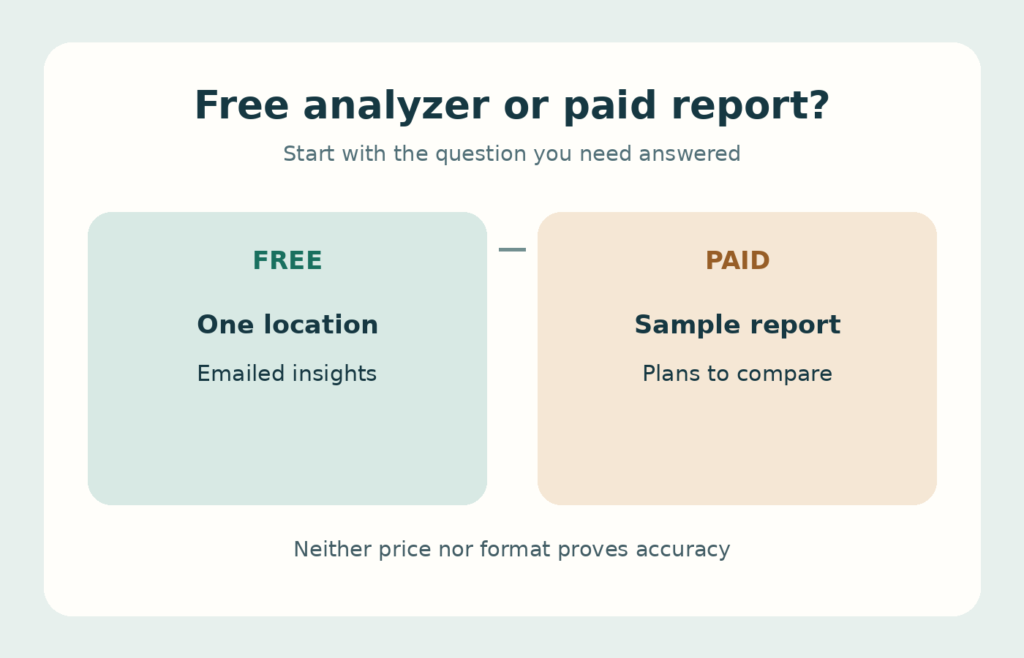
A free tool can give you a useful read on Google reviews. So what are you buying when you pay for a report? The answer is not automatically “better AI.” A fair free Google review analyzer vs paid report comparison starts with the output you can inspect, the decision you need to make, and the questions neither product page answers. If your team only needs an initial map of recurring comments at one location, spending nothing may be sensible. If you need a particular report format to discuss at a branch meeting, examine that format before paying.
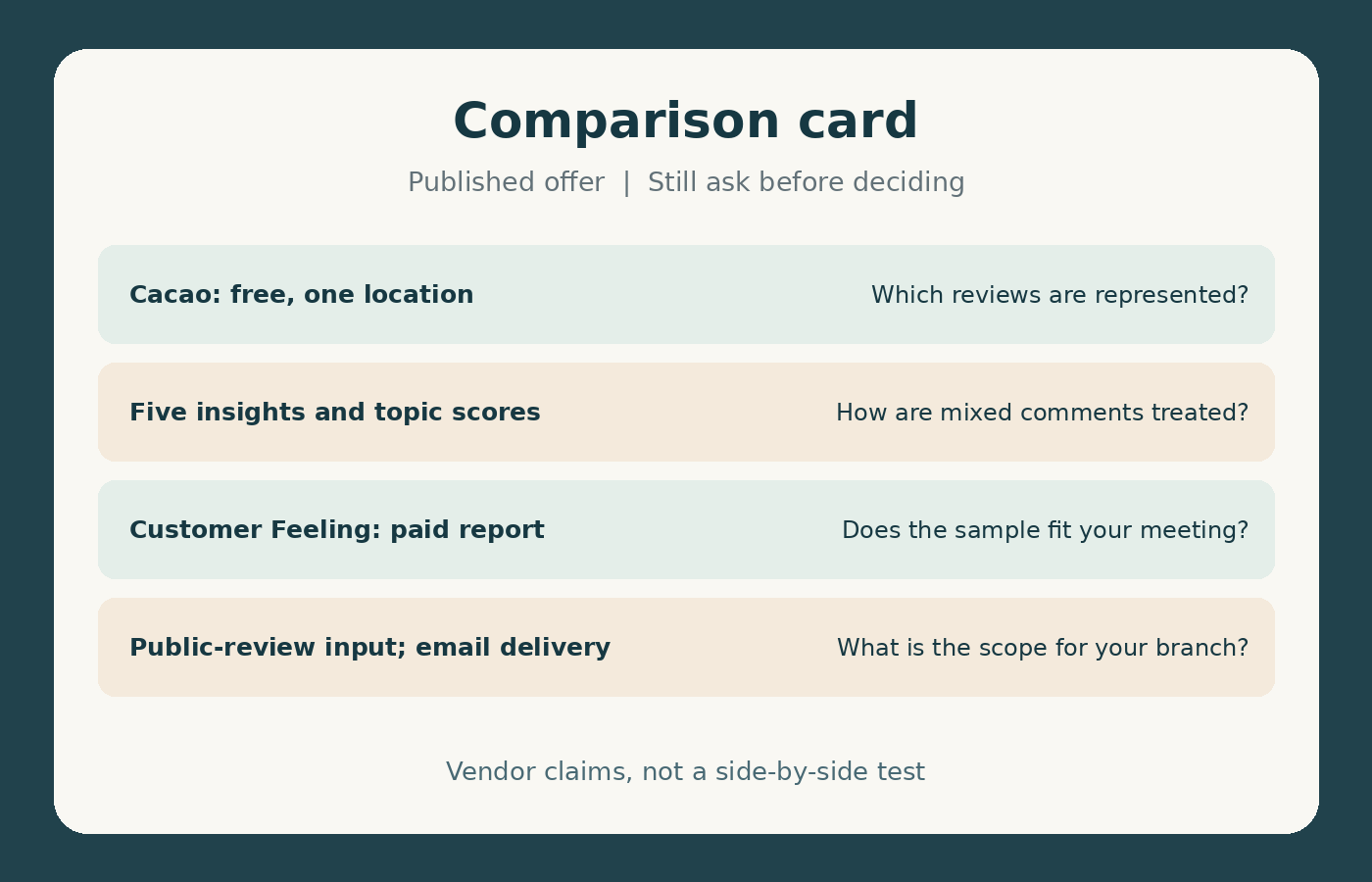
This is a buyer’s comparison, not a test of either service’s actual output. Cacao advertises a free Google review analyzer; Customer Feeling review analysis is sold as report credits and a monthly option. Their published pages describe different outputs. We have not submitted a location to either service, timed delivery, checked review coverage, or independently compared their accuracy.
A free emailed analysis option already exists
Cacao’s page says you can search for a business, select one Google Business Profile location, enter an email address, and receive a report without creating an account or connecting the profile. It describes five AI-generated insights, with categories based on what reviewers discuss, a score out of five for each category, and an explanation of the scores. The page also says its free analysis considers all publicly available Google reviews for the selected location. These are Cacao’s claims, not findings from our own trial; the word “all” should not be borrowed as a promise about some other product.
The vendor’s displayed café report is explicitly illustrative. Its example themes tell you how Cacao presents results, but they cannot tell you what your own location will produce. Cacao also describes a separate multi-location analytics product. Do not confuse the free one-location submission with that paid management software, and do not dismiss the free analysis as a mere star-rating checker. Its published scope includes review text, sentiment, recurring topics and explanations.
Compare stated contents, not assumed quality
The table below separates what the two public pages say from what you still need to check. A listed feature is not proof of coverage or analytical correctness. The comparison is about a free report and a paid report, not Cacao’s wider software catalog.
| Buyer question | Cacao free analyzer | Customer Feeling paid report | What to verify |
|---|---|---|---|
| Input and access | Vendor says select one location and give an email; no account or profile connection. | Site says pay through PayPal, send the Maps location and purchase email via contact page; public reviews are the input. | Confirm the exact branch and any review-selection limits. |
| Visible output | Vendor describes five insights, dynamic categories, category scores and explanations. | Site describes recurring praise and complaints, customer sentiment, an executive-style report and practical areas to review; a sample PDF is linked. | Inspect the sample or an actual delivered report against your decision question. |
| Price shown | Free for one location per submission, according to Cacao. | $5 single report, $50 for 20 credits, or $35 monthly for up to 30 reports, on the current English page. | Check the live plan page before checkout; ask about any unclear credit terms. |
| Unknown from this comparison | No independent side-by-side run establishes accuracy, delivery time, matching review sets or usefulness for your business. | Test with a decision you already need to make; do not infer a winner from price. | |
The missing facts matter. A score can be easy to read but still hide mixed feedback; a longer narrative can feel thorough while overlooking the complaint you care about. Neither price nor page length establishes which report interprets your reviews better. Ask what evidence sits behind a category, how a contradictory comment is treated, and whether a practical suggestion can be traced back to review text. Those are evaluation questions, not assertions about either vendor’s methods.
What Customer Feeling shows before you buy
Customer Feeling’s English homepage currently lists a $5 single report, a $50 pack of 20 report credits, and a $35 monthly subscription allowing up to 30 reports per month. It says the 20 credits can be used across locations with the same purchase email. The single report is presented as a way to try the service before choosing a larger pack. Prices and package descriptions can change, so use the current pricing section rather than treating this paragraph as a checkout quote.
The homepage says a buyer pays through PayPal, then sends a Google Maps location and purchase email using the contact page. The service analyzes available public reviews and emails a report. You do not have to share a Google account password. It describes recurring strengths, complaints and recommendations to discuss with managers or branch teams. Those are the site’s published service terms; this article has not placed an order or independently verified a delivered report.
View a sample report before deciding. The PDF shows an executive summary, indicators, strengths, weaknesses, main complaints, frequent topics and proposed improvements. It contains example counts and percentages for a masked restaurant. They belong to the specimen, not to your business, and should not be treated as a guaranteed number of reviews analyzed or a standard result. Notice that the specimen distinguishes reviews used in its example analysis from reviews fetched. That makes coverage a particularly good question to ask, rather than assuming every public review appears in any future report.
Ask about coverage, ambiguous text and delivery
Before paying, name the location precisely. Businesses with similar names and nearby branches can be easy to confuse. Keep a direct Maps link handy. Then ask what “available public reviews” means in the report you would receive: whether there is a date window, whether every accessible review is examined, and what happens when little written text exists. We have not verified those details for Customer Feeling. Do not assume the specimen’s time period or review counts are default settings.
A useful test case is a review that says the food was good but the queue was not. Would the report place that under both subjects, or flatten it into one sentiment? Another is a complaint with no specific cause. If your purchase decision depends on a precise interpretation, ask how the report explains uncertainty instead of demanding a confident label for every sentence. You could also ask what evidence supports a suggested action. This is a request for clarity, not a claim that the supplier provides review-level citations.
Neither page inspection here establishes an exact turnaround time. If you need the report before a meeting, ask when to expect it and what happens if the location link is wrong. The Contact us page invites questions about report contents and packages. Avoid sending passwords or sensitive payment details; the contact page specifically says they are not needed. For Cacao, check the free tool’s current terms before submitting your email and location.
No Google login is not the dividing line
Both public offers describe working from public reviews without access to your Google account. Cacao explicitly says there is no account or Google Business Profile connection for its free analyzer. Customer Feeling says it works with publicly available reviews and does not require your Google password. Calling either one uniquely “no login” would mislead a buyer. The more meaningful distinction may be whether its published output fits a particular task, and whether the price is acceptable for that task.
Neither report is a substitute for the original review or for a conversation with staff. Public comments may be thin, dated, contradictory or about a different issue than the one you are investigating. A report can organize text, but a manager still has to check whether a proposed fix matches what happened on the floor. Nor should you use analysis to pressure customers into changing their reviews. Google’s Maps contribution policy calls for genuine experiences and prohibits paid or incentivized reviews and selective solicitation of positive feedback.
Use a small test only when it answers a real decision
Start with the decision, not the tool. Suppose you need to decide whether a branch meeting should focus on waiting times or a different recurring complaint. The free emailed analysis may give you enough direction. If it doesn’t, write down what is missing: a report structure your team can use, clearer separation of strengths and complaints, or recommendations to discuss. Compare those needs with Customer Feeling’s published sample. The first paid step offered is a single report, not a 20-credit commitment.
After any report arrives, choose one concern and check it against the actual review text and your operational records. Keep the two sources separate. A frequent theme in a report is a prompt to investigate, not proof that a named employee caused it or that an intervention will raise your rating. If no reviews contain enough detail to resolve your question, buying another summary may not help. Ask customers about their experience through appropriate channels instead, without incentives or pressure for particular ratings.
If you manage several branches, map the number of locations and how often you expect to revisit them before considering credits or a subscription. Cacao’s free page says one location per submission; Customer Feeling’s paid page describes credits usable across locations with the same email. That does not by itself make either offer a multi-location dashboard or establish a favorable cost per useful finding. Check today’s prices and ask about terms that matter to your team before checkout.
Frequently asked questions
Can I get a Google review analysis free?
Yes. Cacao currently advertises a free emailed analysis for one selected location per submission, without connecting a Google Business Profile. Its page describes five generated insights and category scores. We have not independently tested the resulting report or verified its claim to consider all public reviews.
Is a paid report necessarily more accurate?
No conclusion about relative accuracy follows from the price. This article compares the published offers and Customer Feeling’s sample PDF, not two reports produced from the same location at the same time. Judge any delivered analysis against specific review text and the decision you need to make.
Does Customer Feeling offer a free report?
Its English pricing page lists a paid $5 single report, a 20-credit pack and a monthly option; it does not advertise a free report there. You can inspect the linked sample PDF without purchasing. Verify the live pricing page if you plan to buy.
Do I need to connect my Google account?
Neither published offer says you need to provide a Google account password for this analysis. Cacao says its free tool needs a selected location and email, while Customer Feeling asks for a Maps location and purchase email after payment. Confirm any remaining access questions directly with the relevant vendor.