
Is a paid report worth it? A review analysis report ROI worksheet
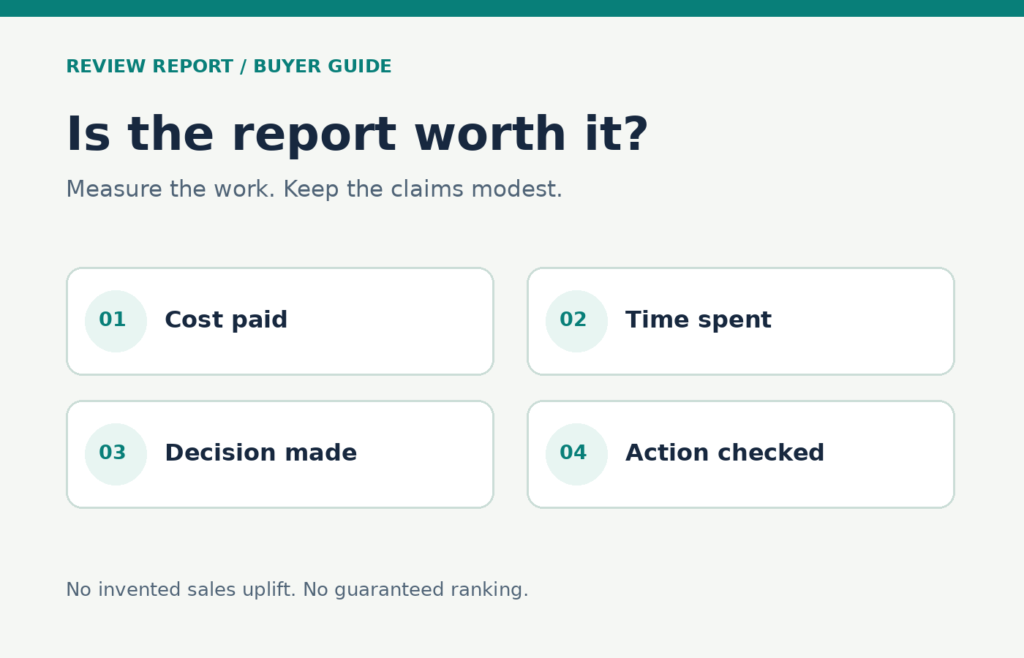
What would make a review report worth paying for at your location? A useful answer starts with a decision you can name, not a promise that a document will raise sales. For a buyer considering review analysis report ROI, the purchase price is only one cost. Someone has to read the findings, check them against the shop floor, and decide what to change. Some changes cost nothing; others require staff time or equipment. Unless you record those inputs, a positive-looking return is just a guess.
Customer Feeling review analysis describes reports based on available public Google Maps reviews, with recurring strengths, complaints, and practical areas to inspect. Its page currently lists a single-report option and a twenty-credit pack. Those are published offers, not evidence that any particular buyer will recover the price. This guide gives you a blank cost-benefit worksheet and a way to use it without attributing every later sale to a report.
Separate the report cost from implementation cost
Start with the amount actually paid for the report used in this decision. The current Customer Feeling page displays a $5 single-report option and a $50 twenty-credit pack. Check the live checkout before purchasing; displayed terms can change. Do not divide a pack price by its maximum credits and call the result your realized cost if half the credits are never used. Record the invoice amount, credits actually used, and the period over which you are evaluating them.
Then list the costs that follow the report. A manager might check a complaint about waiting time against a shift log, speak with staff, or observe a busy service window. If a test changes scheduling, count the hours spent preparing and carrying it out. If a proposed fix needs a new process or equipment, price that separately. A report may help identify where to look; it does not perform the investigation or the repair. Keep the original report fee and the chosen intervention in separate columns so a reader can tell whether an expensive change was justified by evidence beyond the report.
Record actual reading and meeting time
Staff time is easy to omit because it does not appear on the receipt. Log the minutes each person actually spends reading, checking, meeting, and following up. Use an internally agreed hourly cost, with the basis stated, rather than borrowing a generic wage from an online calculator. If salaried staff would have spent that hour on another task, note the displaced work. If they used spare capacity, a full billed-hour rate may overstate the incremental cash cost. Either way, the assumption should be visible.
Set a stop rule before you open the file. For example, decide which manager will review the report, how long the first review is allowed to take, and whether a second meeting needs a specific question. These are management choices, not Customer Feeling product features. If your team already reads every new review and maintains a useful issue log, compare the report with that existing workflow. The relevant benefit may be a clearer discussion or less sorting time, but count only time that genuinely disappeared.
A simple time log needs person, task, date, elapsed minutes, and cost assumption. Leave the hourly-rate box blank until your finance or operations owner supplies it. If several branches share a meeting, allocate its time consistently rather than charging it in full to every report. A small amount of honest measurement beats a polished spreadsheet built on a guessed rate.
Track decisions made and actions completed
Before buying, write a question the report could help answer. “Which recurring complaint should the branch investigate first?” is testable. “Will this increase revenue?” is not a question the report alone can settle. Once it arrives, record the cited theme, the person responsible for checking it, the operational source used for comparison, and the decision. A decision can be to act, gather more evidence, or decline the recommendation. All three have value if they prevent unfocused spending.
Next, distinguish an assigned action from a completed one. A meeting note saying “improve service” tells you very little. A dated shift observation, a revised handoff instruction, or a manager’s check of a recurring wait-time complaint gives you something to revisit. These are examples of what a business could choose to do, not case studies or functions promised by the vendor. Keep the evidence trail short enough that staff will actually maintain it.
Compare later customer feedback with the original theme, but avoid a premature victory lap. Reviews arrive unevenly, customers may mention different parts of the experience, and a quiet week is not proof that a fix worked. Pair the later comments with your own operational measure when one exists. For a waiting-time investigation, that might be a separately maintained timing record. Do not describe an internally collected metric as something the review report itself produced.
Keep revenue attribution cautious
A review analysis report is a prompt to investigate, not a sales intervention with a built-in control group. Revenue can change because of seasonality, pricing, staffing, promotions, weather, or customer mix. Even if sales rise after a report and a process change, the sequence alone does not establish causation. State the chain honestly: the report raised an issue, the team verified it, the team changed a process, and the business observed a later result. If any link is missing, say so.
You can monitor separate indicators without treating them as report-generated income. Google says verified Business Profile owners and managers can view performance such as views, calls, website clicks, and other applicable interactions, though not every metric applies to every business. That is data in the owner’s own profile, not private performance data supplied by Customer Feeling. A phone click is also not a completed purchase. Google’s performance guidance explains the scope and access conditions.
Be especially wary of ranking claims. Google’s local ranking guidance describes relevance, distance, and popularity, and says there is no way to request or pay for better local ranking. A report might identify complaints worth examining; it cannot guarantee search position. In a budget review, present verified process outcomes first and label any possible contribution to sales as a hypothesis until you have stronger evidence.
A blank cost-benefit worksheet with explicit assumptions
Copy the fields below into a sheet or notebook. The image is a visual reminder, not a worked example with fictional numbers. Fill one worksheet per decision or location, and keep the underlying receipt and time log. A blank cell is preferable to a convenient invented value.
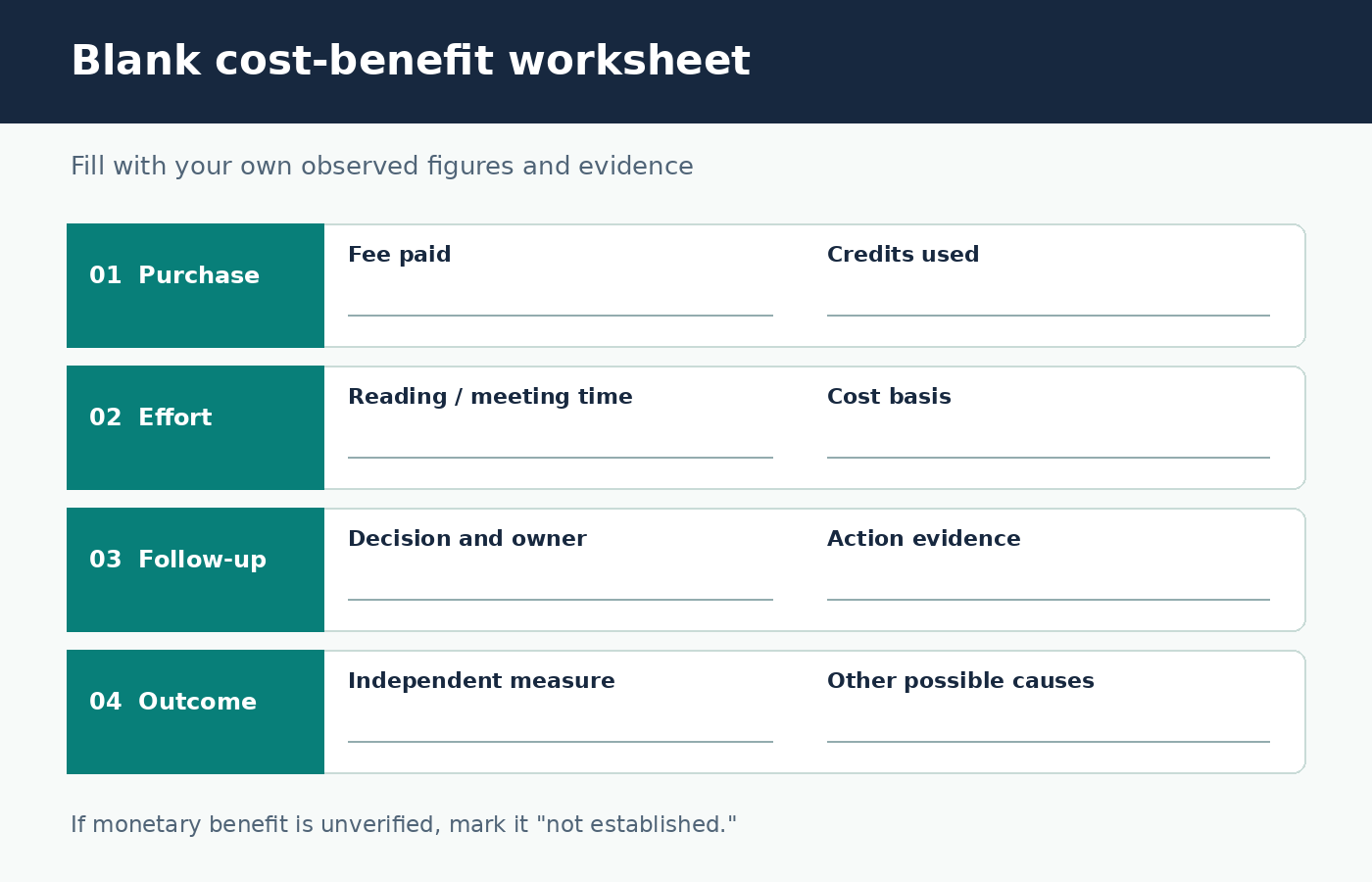
- Location and decision question: ______ ; decision owner: ______ ; review period: ______.
- Report fee actually paid: ______ ; pack or subscription allocation rule, if relevant: ______ ; credits used: ______.
- Reading time by person and task: ______ ; meeting time: ______ ; hourly cost basis: ______ ; calculated staff cost: ______.
- Implementation or test expense: ______ ; source of actual expense: ______ ; costs not yet known: ______.
- Theme from report: ______ ; corroborating operational evidence: ______ ; contrary evidence: ______.
- Decision and date: ______ ; action owner: ______ ; completion evidence: ______ ; follow-up date: ______.
- Outcome measured independently: ______ ; baseline and comparable period: ______ ; other possible causes: ______.
- Verified monetary benefit, if supportable: ______ ; reason and source: ______ ; otherwise mark “not established.”
For an internal calculation, total actual cost equals the report allocation plus measured staff cost plus implementation spend. If you have defensible monetary benefit, net benefit equals that benefit less total actual cost; divide net benefit by total cost only when the denominator is positive and the benefit attribution is credible. Otherwise report costs, completed actions, and unresolved outcomes rather than a percentage. This is a bookkeeping framework, not a projection of what Customer Feeling or any report will deliver.
Before you commit to a larger purchase, View a sample report. It shows a format with a summary, indicators, themes, and recommendations; its illustrative business and figures are not a measured result for your location. Ask whether that format would help the named decision. If review coverage, method, or a specific location raises a question the public pages do not answer, Contact us before paying rather than filling the gap with assumptions.
When the report is not worth buying
Hold off if you have no decision owner, no time to check the findings, or no way to distinguish a report’s suggestions from information you already have. If there are very few substantive public reviews for the location, the available text may be too thin for the question you want answered. Customer Feeling itself notes that detail depends on the number and substance of available reviews. Paying for a larger pack before trying the format can also make the apparent per-report price irrelevant if the credits go unused.
Buying may still be reasonable when a manager has a specific question, enough public feedback to inspect, and a plan to verify at least one issue. Test the smallest suitable option against that question. Keep the choice to continue, change course, or stop open after reading the first report. The useful result might be a decision not to spend on an intervention that customer comments do not support. Do not disguise that judgment as revenue growth.
Review the plans against your question and location needs. Check the published options and the sample, then choose only the volume you can realistically review.
Frequently asked questions
Can a report guarantee more sales?
No. A report based on public reviews can surface issues to investigate. Sales depend on many factors and on what the business does afterward. Track actual actions and independently observed outcomes; do not assign all later revenue to the document.
How should staff time be valued?
Record actual minutes by person and task, then use a cost basis agreed by your business. State whether the figure is a cash outlay, a labor-cost allocation, or an estimate of displaced work. Do not mix these interpretations in a single total without explaining them.
Which outcomes can a small business verify?
It can verify the fee paid, time spent, decisions documented, actions completed, and its own operational measures if it records them. Later reviews and applicable Business Profile interactions may offer context, but neither automatically proves incremental sales caused by the report.
Should I buy a pack before trying one report?
Only if you know who will use the credits and why. The published single-report option and sample let you inspect the format first. Compare actual usage with the pack terms before calculating a unit cost.