
When to repeat Google review analysis after service change
A cafe manager changes the handoff at the counter because customers keep describing missing items. A month later, the manager wants to know whether to buy another review report. A repeat Google review analysis after service change helps only if new comments address a specific operational question. If old reviews dominate both reports, the purchase may merely repeat the first.
Customer Feeling review analysis describes a PDF report and Excel evidence register built from available public Google Maps reviews, with recurring praise and complaints. Its current request flow lets an account holder select a period of 1 to 90 days, including both endpoints. Yet a selected period is not a guarantee that every historical review or a precise publication date can be retrieved. Here is a way to decide whether to buy again, wait for more evidence, or investigate through another channel.
Write down the change before looking for a new score
Describe the intervention in terms a colleague could observe. “Improve service” is too broad. “Ask the counter employee to repeat the order before handing over the bag” identifies a behavior. Record when the new practice started, which location uses it, who checks compliance, and what remained unchanged. If staff training and a menu redesign happened together, record both. Later comments cannot tell you which change mattered unless the customer actually says so, and even then the comment is one person’s account.
Keep your original question beside the first report. Was the concern missed items, unclear wait estimates, or unfriendly interactions? A report about all three may be informative, but the follow-up decision should name the issue you tried to fix. Otherwise it is easy to celebrate new praise for food while quietly forgetting that the handoff complaint persists. Write a modest success criterion: fewer detailed descriptions of missing items among new comments, alongside your own checks of order accuracy. It is a question to investigate, not a threshold that a report vendor guarantees.
Inspect the new evidence before ordering anything
Open the location’s public reviews and read the comments that appear relevant to the period after the change. Count comments with useful detail rather than treating every new star rating as a description of the process. Does anyone mention the counter handoff, missing items or a related experience? A fresh review that only says “great coffee” does not tell you how the handoff works. Nor does silence about missing items establish that nobody experienced one.
There is no universal number of new reviews that makes a second analysis worthwhile. A location with a handful of concrete new accounts may have a useful question for a manager to check; a location with many ratings but little text may have almost nothing about the changed process. Look at relevance, specificity and whether the comments describe the branch you changed. If nearly all new text concerns another service, postpone a repeat report focused on the handoff and speak with customers directly instead.
Review dates also need care. Google says a customer may change a review after reading a business reply, and the displayed review date changes to reflect the latest update. An apparently recent review is therefore not always a new customer’s post-change visit. Do not silently sort every dated entry into a clean cohort. Mark ambiguous cases, especially when the text refers to an earlier experience. Google also notes that review availability can vary by country and category; check what is actually visible for your location rather than assuming a complete dataset.
Use this quick readiness question: “If I pay for a second report today, what new statements about this exact process could it reasonably discuss?” If you cannot point to any, wait. Continue checking the operation internally rather than waiting for public reviews to do the entire job.
Ask what comparison the provider can really supply
The current Customer Feeling page allows a selected start and end date within a 1-to-90-day inclusive period for a request. It also warns that access to older reviews or precise dates may be limited, and that source coverage is not a complete historical record. This is a date selection, not a guaranteed new-review-only cohort or an automatic before-and-after comparison. Its linked sample report shows one specimen, not a guarantee of the exact review count or coverage your location will receive. Ask how a report discloses missing or ambiguous review dates before relying on a comparison.
Note the location and actual service-change date, then choose a requested period that makes sense within the stated limit. Ask how the report handles reviews with unverifiable dates, and what happens if very few relevant reviews are available. A selected window alone does not prove that every included comment describes a post-change visit. If the change reached staff gradually, do not force a hard boundary onto an uneven rollout.
Do not assume reports run automatically. The current English page lists one-time credit purchases: one credit for a single-business request, or a twenty-credit pack; it says the listed credits do not expire. It no longer lists a monthly subscription. Request submission takes place in the account dashboard; after processing and file checks, the PDF and Excel files are downloaded there and an email notice is sent. If you are uncertain about repeat-request workflow, use the contact page before buying. Never send a Google password or payment credentials with that inquiry.
Compare themes with a small, honest worksheet
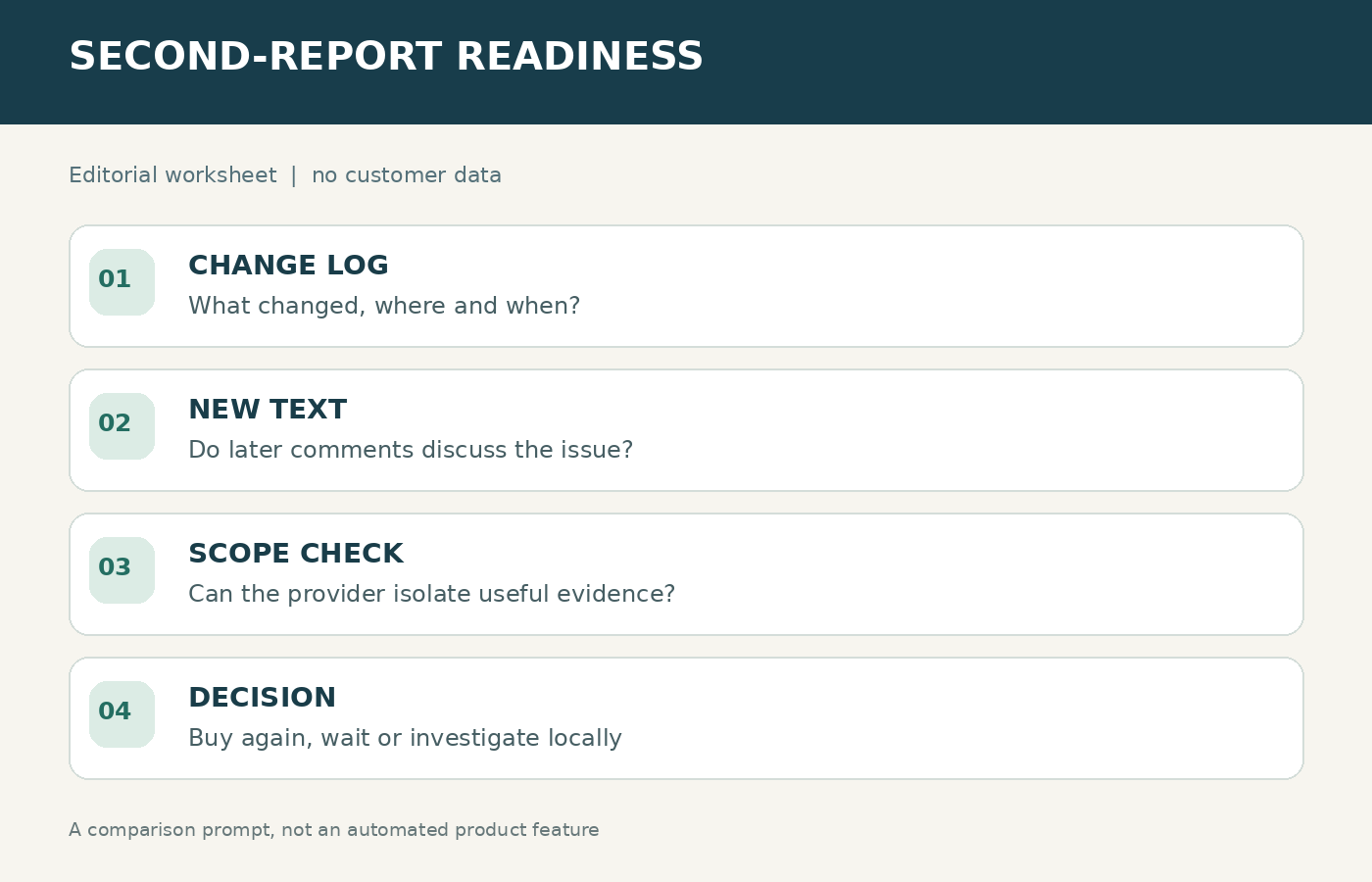
You can compare two reports manually without pretending they form a controlled experiment. Create one row per issue named in the original report. Put the earlier wording in one column, the later wording in another, then add three separate fields: relevant new public comments, your internal check, and an unresolved question. Keep the language close to what reviewers actually wrote. “A reviewer said an item was missing” is not the same as “the packing system failed.” The second sentence requires a check of the order and packing process.
For the cafe example, a row might read: original theme, missed items at pickup; change, verbal order confirmation at handoff; later text, two comments about pickup, neither mentioning missing items; internal check, shift manager audited a sample of handoffs; unresolved, whether a silent customer still received an incomplete order. Those details are an illustrative worksheet, not a real customer case or a feature inside the product. Leave blank cells blank if you have no evidence. A fabricated count looks decisive only until someone asks where it came from.
The accompanying diagram is an editorial readiness timeline, not a product dashboard. Keep both reports and the location link together; check internal records locally rather than sending them to a public-review analysis service.
When the topics differ, say so. Perhaps the original report discussed pickup delays, while the new comments discuss seating. The later report may still reveal a useful issue, but it did not test the pickup fix. Likewise, an old complaint appearing again in a new summary might be carried by old review text. Before calling it a recurrence, identify whether a genuinely later account raises it.
Look for explanations other than your intervention
Service changes rarely occur in isolation. A quiet weekday period and a holiday rush expose customers to different waits. Staffing changes, hours, product availability and a different mix of visitors can change the subjects people mention. If one branch changed its process and another did not, do not merge their reviews into one verdict. Public reviewers are self-selected; their comments are valuable signals but not a census of everyone served.
Ask the manager what their own records say. For an order-handoff change, examine order corrections or a small set of manual checks, if such records exist. For a wait-time change, compare the relevant queue observations rather than an unrelated sales total. Keep private information in your own systems and discuss only aggregated operational findings with the team. If internal checks show repeated misses while newer reviews are positive, do not declare victory. If reviews still complain but internal checks look clean, investigate the discrepancy instead of dismissing the customer account.
Google Business Profile Performance is a different source of evidence. Verified owners and managers signed in to the associated account can select a period for applicable views and interactions. That date selection is Google’s native tool, separate from Customer Feeling’s review-period selection. Profile clicks cannot prove a handoff improved.
Choose a second report, a pause, or a different investigation
Buy another report when the first one raised a well-defined issue, the change is documented, relevant new written reviews exist, and the available date window can answer the question you have. If dates or coverage are incomplete, it might still help you see recurring themes, but describe that as an overview rather than a measured before-and-after result. A one-credit purchase may suit a cautious first repeat request; multiple businesses in one comparison use a credit per business.
Wait when the change was recent, customers have not yet described the affected experience, or you cannot identify which shifts adopted it. Waiting does not mean doing nothing: sample the handoff yourself, ask frontline staff what they observe, and invite direct customer feedback through your ordinary channels. Investigate another way when the question requires transaction-level facts, such as whether a particular order was complete. Public review text cannot establish that on its own.
Write the decision in one sentence before spending: “We will request a second public-review overview for this location because [new relevant evidence] and use it to examine [specific question], while checking [internal record] separately.” If you cannot fill those brackets honestly, a purchase is premature. Review the plans against your question and location needs, and confirm any comparison or timing requirement with the provider before checkout.
Frequently asked questions
Does the subscription run reports automatically?
The current English homepage no longer lists a subscription. It lists one-time credit purchases and an account-based request flow. Nothing there verifies automatic scheduling or monitoring. If you saw an older monthly offer, confirm its current availability and terms directly before relying on it.
Can I choose a review date range?
Yes. The current service page says you choose start and end dates for a 1-to-90-day period, counting both dates. It also warns that source coverage and verifiable review dates may limit what can be included. A selected window is not proof that every matching review was retrieved or first written after the change.
Does fewer complaints prove the change worked?
No. A smaller number of complaint comments might reflect fewer relevant reviewers, different traffic, older text in the analysis, or a genuine change. Compare the wording and context of newer reviews with your own operational checks, and keep the conclusion appropriately narrow.