
Google review analysis for retail stores: separate stock complaints from staff complaints
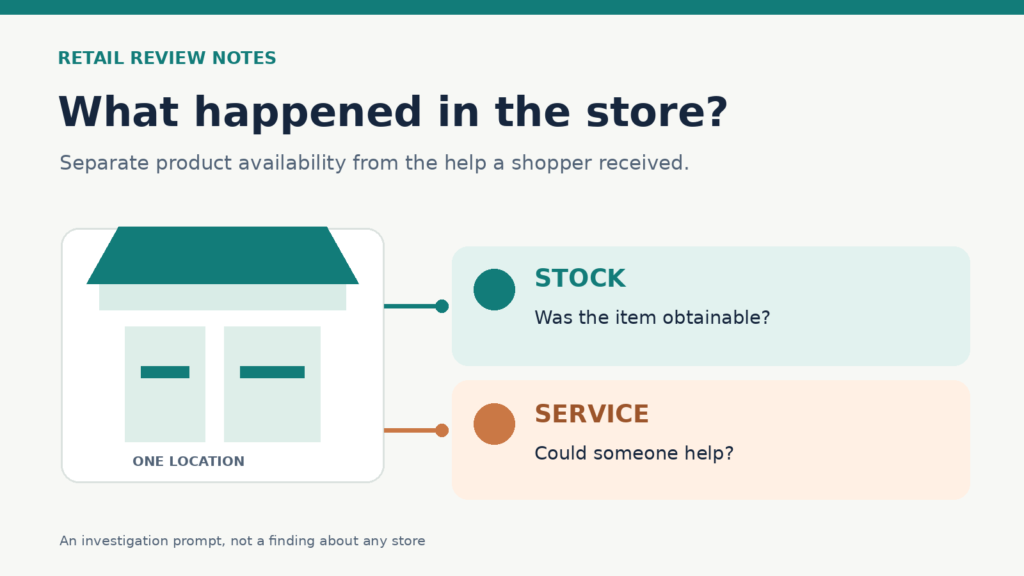
When a shopper says a store had nothing they wanted, should the owner buy more stock or coach the floor team? The sentence alone cannot answer that. The item may have sold out, been in the back room, appeared unavailable because the shelf was empty, or simply been hard to find. If an employee offered no help, the same visit also contains a service complaint. Spending on the wrong fix is easy when those experiences are merged into a single label.
Google review analysis for retail stores is useful when it frames that choice as an investigation, not a vote on which department deserves blame. Public comments can reveal what shoppers say happened; they do not show the stock ledger, replenishment timing, rota or full conversation at the counter. A report can identify recurring themes worth checking against those records. It cannot establish why a specific product was unavailable on a particular visit.
Customer Feeling review analysis describes an emailed report based on available public reviews for the Google Maps location you provide. Its site says it groups recurring praise and complaints and suggests areas to examine. For a retailer, the purchasing question is whether that outside view would help narrow a stock-versus-service decision before the team commits time or money. The method below is an editorial worksheet for the owner; it is not an advertised feature of the service.
Choose the budget decision to investigate
Start with a choice you can actually make. Perhaps you are deciding between more frequent shelf checks and more floor coverage at busy times. Perhaps the proposed spend is a stockroom reorganization rather than another employee shift. Write the competing hypotheses down before reading the comments: shoppers could not buy because the product was absent, or they could not get help locating and choosing a product that was available. Both may be true.
Do not ask a report to calculate lost sales or tell you how many people walked away. Reviewers are self-selected, and many shoppers leave no written review. Even a repeated complaint is evidence of a perceived problem, not a representative stockout rate. A silent period is not proof that the shelves were full or that the team performed well.
Separate availability, advice and checkout
The phrase “never have what I need” sounds like inventory, but it lacks a product, date and account of how the shopper checked. Record it as a perceived availability issue, not a verified stockout. A named size missing from a rack is more specific, yet the store still needs to check whether that size was delivered, displayed elsewhere, reserved, or sold earlier that day. Avoid assigning a root cause from the review alone.
Comments about advice belong in another lane. “Nobody could explain the difference between the two models” concerns product knowledge or access to assistance. “I asked twice and was ignored” concerns the encounter with staff. “The queue took too long” concerns checkout capacity or flow, though a review cannot tell you exactly how many employees were scheduled. Product quality and returns can form further lanes if they appear, but do not force every comment into the stock-versus-staff comparison.
Recognize comments with multiple causes
Consider this invented example, not a real review or customer result: “The website showed the jacket in my size, but the rack was empty and nobody checked the back.” There are at least two unresolved questions. Was the online availability signal accurate for this location? Did the floor team have a practical way to check? Mark it “availability claim plus help gap” and leave the cause open. Do not quietly count it twice as two independent lost sales.
Where the reviewer gives no detail, use an “unclear” lane. Do not infer an employee’s identity, a SKU or the exact visit time from a name or profile photo. If a reply is appropriate, Google says approved business replies are posted publicly. Keep transaction details out of the reply and take any individual follow-up through a suitable private channel.
Use a stock-versus-service investigation matrix
This matrix is a blank decision aid, not a Customer Feeling output or a finding about any store. Fill its evidence column with your own records only after you have a theme to examine. The sample language is fictional and illustrates classification, not measured frequency.
| Review signal to watch | Working lane | Check inside the store | Owner and first question |
|---|---|---|---|
| “My size was missing from the rack” | Perceived availability | SKU and size inventory, shelf checks, receipts and replenishment notes | Stock lead: was it absent, misplaced or not yet replenished? |
| “Nobody checked whether it was in back” | Service or process | Floor coverage, stock lookup procedure and escalation route | Store manager: could a team member check and explain the result? |
| “Online said available; the shelf was empty” | Mixed or unresolved | Channel availability rules, location-level records and shelf check | Inventory and store leads: where did the signal and visit diverge? |
| “I waited at checkout with my item” | Checkout experience | Queue observation and shift coverage | Operations lead: when and where did the wait occur? |
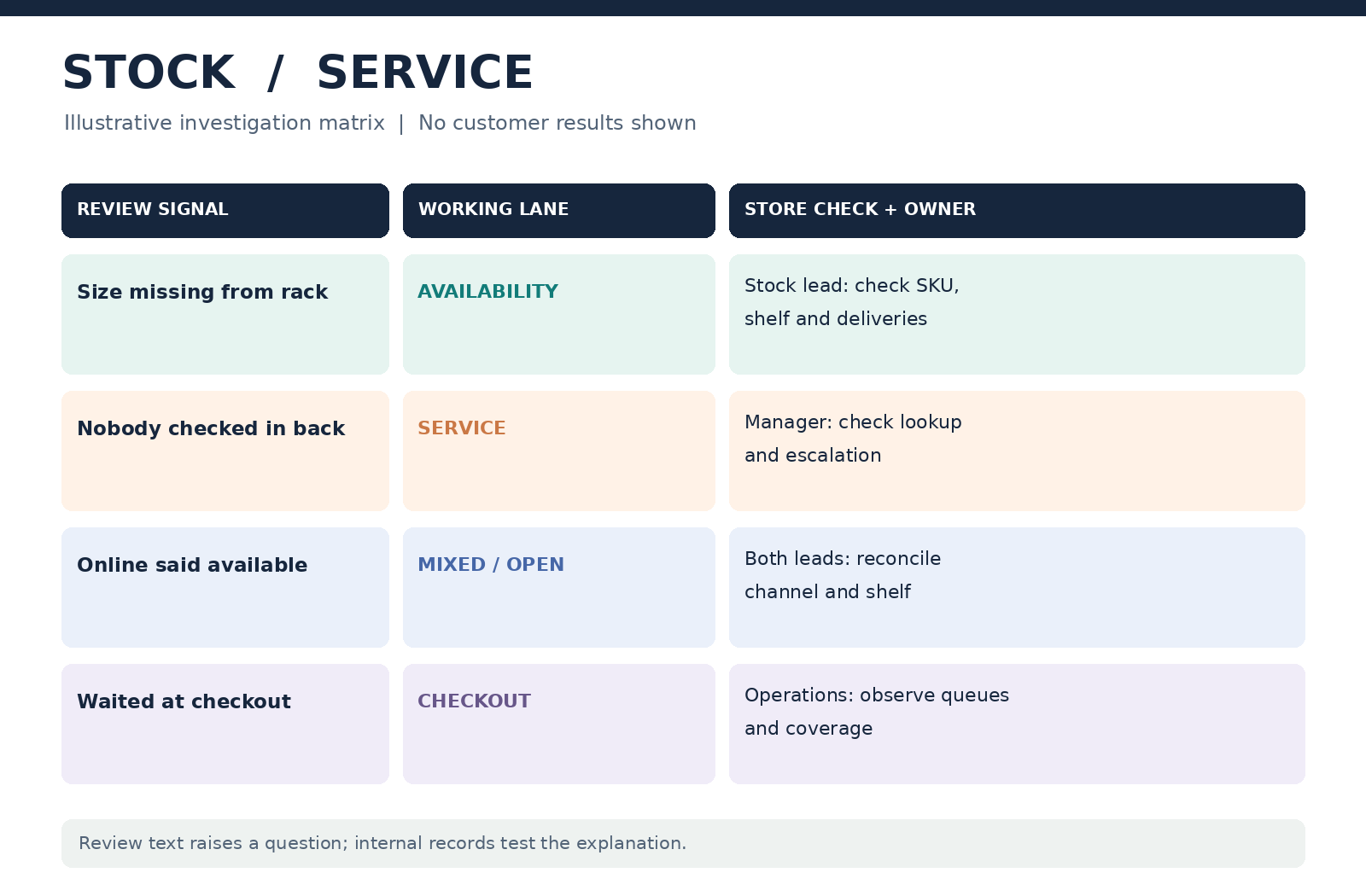
Notice that the first row does not order extra units. It asks whether there really was a gap and what kind. The second does not accuse an individual employee. It asks whether the team had a workable process. The mixed row assigns a shared investigation rather than pushing the same complaint onto two departments. Use separate notes for what the review explicitly says, what remains unknown and what an internal check later establishes.
Validate inventory claims with stock records
A review is not a real-time stock counter. To investigate a repeated availability theme, first look for a product or category the reviewer actually named. Then compare the period of the comment, where discernible, with inventory movements, delivery records, sales and shelf checks at that location. If the visit date or product is unknown, state the limitation and investigate the broader shelf process instead of manufacturing a match.
Stock systems need their own scrutiny. A recorded unit may be in transit, reserved, damaged, mis-shelved or awaiting replenishment. Shopify’s inventory setup guidance, for example, treats locations and tracked quantities as explicit configuration choices and recommends testing whether quantity changes behave as expected. That is general platform guidance, not a claim about your store’s software or Customer Feeling. Physical shelf observations and staff explanations still matter when reconciling a customer’s experience with a database entry.
Keep the comparison internal. The Customer Feeling page describes analysis of public Google Maps reviews; it does not advertise a connection to your inventory system, point-of-sale records or employee schedule. Do not send those private records to a report provider on the assumption that integration exists. If you need that capability, ask about it before purchase. A manager can use a report’s themes as a prompt and do the operational verification with authorized colleagues and existing tools.
Decide whether a store-level report is a useful first step
Before buying, skim the public reviews for the specific Google Maps location. Are there written comments about particular products, helpfulness or checkout, or mostly ratings with no explanation? Do multiple people describe a similar friction, or is one vivid incident doing all the work? A report that organizes themes may save sorting effort, but it cannot add detail that the underlying comments do not contain. Its public description also does not promise a particular review count, date filter or stock-specific classification.
View a sample report to judge the format before deciding whether an emailed summary fits your store question. The sample concerns a different kind of business; its figures and findings are not retail benchmarks or a preview of what your shop will receive. If you need proof of a particular product’s stock position or a breakdown by individual shift, plan to obtain that from your own systems, not from public comments.
If the scope is unclear, contact the team with the store’s Google Maps location and your question about stock versus assistance. Ask whether the available public text is likely to support that question, without sending private sales or employee records. If a report seems appropriate, review the plans against your question and location needs. Choose a plan for the number of store reports you actually expect to use, rather than buying credits to compensate for a question the reviews cannot answer.
Frequently asked questions
Can Google reviews measure stock availability?
No. A written review can tell you that a shopper experienced an item as unavailable, perhaps with a product or size named. It cannot calculate the percentage of time that item was in stock, verify the shelf on the visit, or show demand from shoppers who did not post. Use location-level inventory and shelf records for measurement. Treat the public complaint as a lead that deserves a check, especially when similar experiences recur.
Does the service connect to inventory software?
Customer Feeling’s public description says it analyzes available public Google Maps reviews for the location supplied and emails a report. It does not state that an inventory or point-of-sale integration is included. Do not assume one. If integration is essential to your buying decision, ask the provider directly and keep your store records within authorized systems until you know the scope.
How should mixed complaints be handled?
Keep both parts of the comment visible, but do not turn one review into independent proof of two failures. Mark which words describe availability and which describe help from staff; then list the open questions. Have the stock owner check availability and the store manager check the service process. Only after those checks should anyone choose a purchasing or coaching response.
What if the reviews are too vague to separate stock from service?
Say so. “Bad experience” has no reliable stock or staff signal, and a cluster of star-only reviews does not fill the gap. You may still learn that customers are unhappy, but not which budget to change. Observe the shelf and customer-assistance process directly, ask shoppers specific questions, or wait for more substantive public feedback before treating a report as a decision aid.